

Material and Cupertino decoupling are here
Why moving Material and Cupertino out of core Flutter accelerates fixes and development of new features

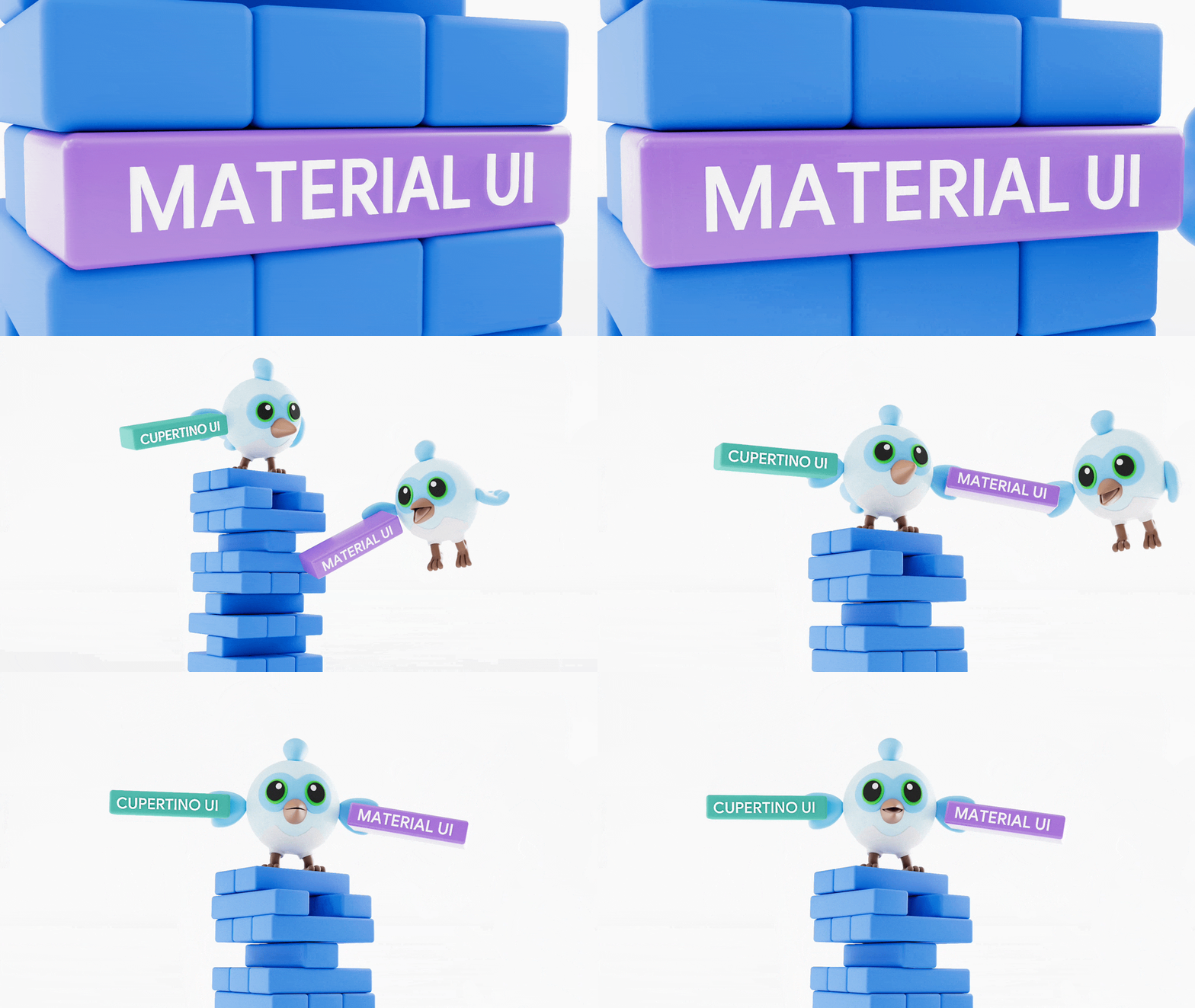
Flutter has always been a "batteries included" framework with great tooling, design systems, animations, and more. But, batteries don't last forever, so it's very important to be able to replace them when needed. Back in 2017 when Flutter was approaching viability, the decision to elevate Material and Cupertino was broadly considered the right decision. Fast forward into the 2020s as that perspective shifted, and the Material and Cupertino batteries started to feel more soldered-on than just included. For years, improving this system was a top request from Flutter developers. And now, in 2026, a long process to grant this developer wish is finally coming to fruition.
What we're doing
Starting months ago and landing in August 2026, this effort froze
contributions to the Material and Cupertino libraries within the
Flutter framework and released exact replicas on pub.dev as the
1.0.01
versions of pkg:material_ui
and pkg:cupertino_ui.
(Those external libraries are not frozen and are ready for contributions!)
Then, at a future date, this effort will complete with deprecation
and eventual removal of the Material and Cupertino libraries from the
Flutter framework itself.
The reasons for pausing other work to complete this maneuver are manyfold, but several are described below.
Reducing friction when updating Flutter
For years, upgrading Flutter for security patches and other fixes necessarily included any Material or Cupertino UI updates. Needless to say, this was a major source of developer friction that kept many teams on older Flutter releases. It also meant that when teams did finally kick off an upgrade, the task could consume multiple weeks of developer effort and bottleneck entire repositories while teams addressed UI changes.
Now that the Material and Cupertino libraries are migrated out of the core framework, we expect that updating Flutter will return to the simple task it should have always been—complicated only when underlying platform changes necessitate a Flutter developer's attention.
Accelerating Material and Cupertino progress
Flutter releases a new stable version every 3 months, which is a pretty fast pace for a project of its scope. However, fast as it is, it still means that the worst case scenario (landing code one minute after the stable release cutoff) can introduce a 16 week delay until that change sees the light of a stable release. That is… not good.
Broken out into their own packages, pkg:material_ui and pkg:cupertino_ui
can now be released on their own weekly schedules. This enables simpler CI
workflows and is easier to contribute to, especially for those unfamiliar
with Flutter’s internals.
For these reasons, we expect Material and Cupertino to accelerate development progress and keep better pace with both Google’s and Apple's design language updates. For example, work is already underway on official implementations of Liquid Glass and Material 3 Expressive. We are working with our community of package authors to ensure Flutter's implementations of these libraries have the best possible quality and compatibility.
Strengthening the base widgets
One of the unintended consequences of elevating the Material and Cupertino
libraries in the Flutter framework was that it proved too tempting to build
foundational functionality in those design libraries. Both were technically
built on top of the plain widgets library, but the widgets library itself
was full of holes and gaps in basic UI concepts.
To rectify this, a portion of the decoupling effort will fill those gaps
in the widgets library to offer a stronger foundation on top of which
developers can build other design languages. The Flutter ecosystem already
supports many design languages, including macos_ui, fluent_ui,
yaru, arna, chicago, VSP, shadcn, and others. In the fullness of time,
we hope to simplify this task by augmenting Flutter's core widgets
with more helpful building blocks.
What we're not doing
The material_ui and cupertino_ui packages on pub.dev will continue
to receive the same attention from the Flutter team itself and,
as of August 13th 2026, are open for contributions from all
Flutter developers. While the Flutter team's resources are limited
and we occasionally have to make hard choices and deprioritize certain initiatives;
this is not that. The Flutter team remains committed to maintaining
excellent offerings for Material and Cupertino so that your Flutter apps
look modern and idiomatic across all the platforms you target.
Looking forward
All projects that live to see their twelfth year have technical debt. The goal is not to avoid such debt entirely, but to identify it and set aside the time and energy to pay it down. For the Flutter team, solving the aforementioned problems has long been on our wish list and we're excited to finally deliver smoother upgrades, faster innovation, and a stronger core widgets library to all of our developers.
To get started, if your apps use flutter/material.dart or
flutter/cupertino.dart, use dart fix to add the new
standalone libraries to your pubspec.yaml file at version 1.0.0
and replace your imports to use the new packages. Our expectation
is that this will be a drop-in maneuver, but
please file an issue
if you encounter any trouble.
If you're a UI developer with expertise in Material or Cupertino, consider contributing to the standalone libraries! As always, we recommend either finding an issue that interests you or filing a feature request for work you would like to complete.
Until next time, Happy Fluttering!
-
To streamline your migration, we intentionally chose version
1.0.0to mark the standalone version which perfectly matches each library's in-framework state. Moving forward, the libraries will evolve using semantic versioning. ↩
More from Flutter
Try Flutter Web with WebAssembly Week
Unlock up to 2x to 5x faster web performance by opting into Wasm compilation today

Flutter Q2 2026 survey — trust, transparency, and an evolving community
The Flutter Q2 2026 user survey results are in! Discover developer satisfaction, trust levels, AI coding tool adoption, and updates on Cupertino widgets.
